Shinjuku Halloween 2026: Street Drinking Restricted from 5pm to 5am
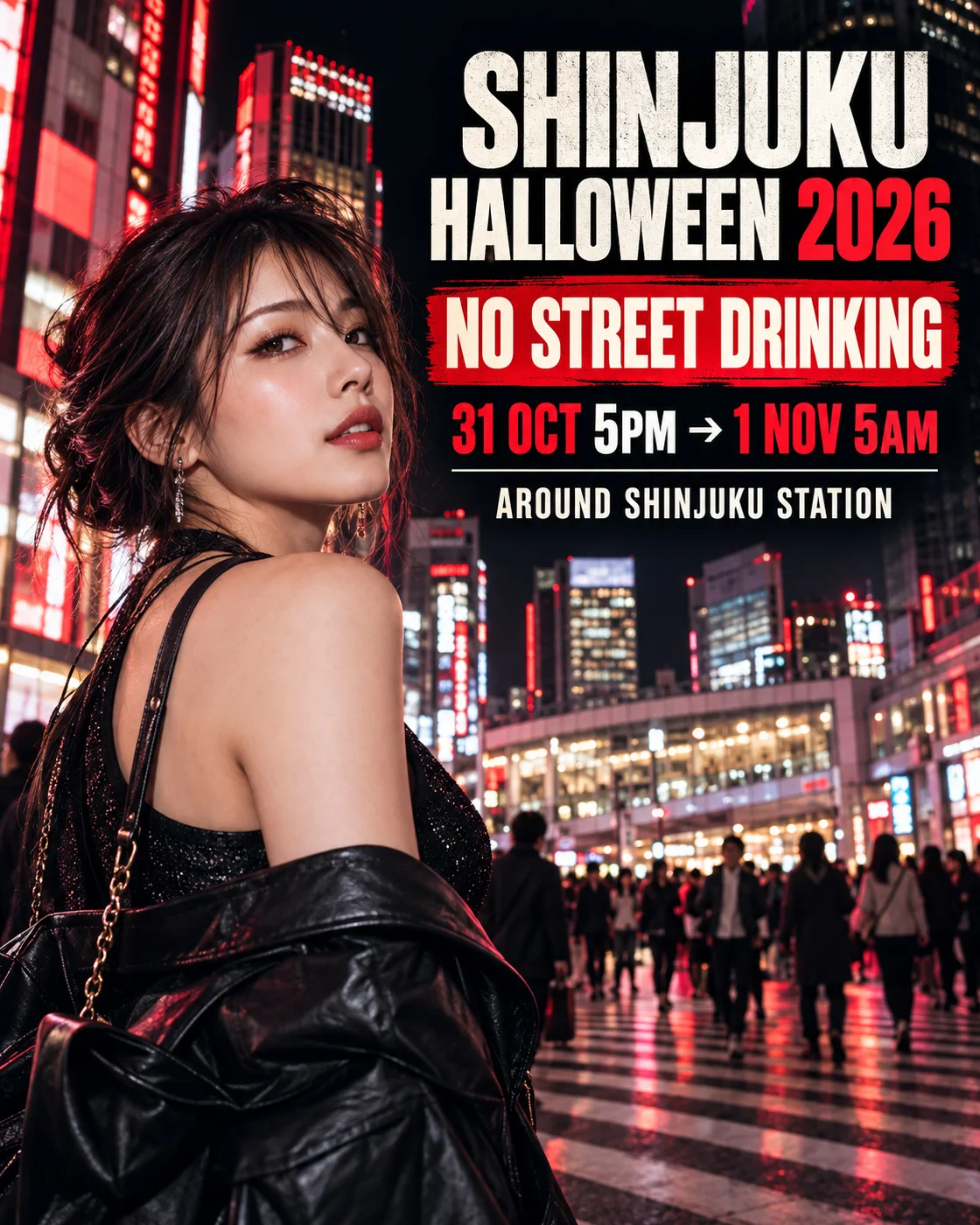
Shinjuku has confirmed its Halloween-night safety measures for 2026. Street drinking will be restricted around Shinjuku Station from 5pm on Saturday 31 October until 5am on Sunday 1 November, with extra staff and security deployed for the expected crowds.

The traveller version: do not plan to drink alcohol on the street around Shinjuku Station during the 12-hour restriction. The measure is about outdoor drinking in the designated station area; it is not an announcement that every bar, restaurant or hotel in Shinjuku will close. Choose a legitimate indoor venue, follow its rules, and allow more time than usual for crowds and station navigation.
What the ward has announced
In a mayoral briefing published on 8 September, Shinjuku Ward said it will restrict street drinking in the area around Shinjuku Station from 5pm on 31 October until 5am the following morning. The stated aim is to prevent nuisance behaviour and accidents caused by excessive concentrations of visitors.
The calendar matters this year: 31 October falls on a Saturday, so the ward expects a particularly large turnout. Its plan includes 45 ward employees and 100 contracted security staff. Shops selling alcohol inside the restriction area, including convenience stores and liquor retailers, will again be asked to refrain from alcohol sales during the period.
That last point is a request to retailers, not a promise that every shop will operate identically. If you intend to go out, the sensible plan is to eat and drink inside a venue you selected in advance rather than arrive carrying alcohol and hope to work out the boundary on a crowded pavement.
What “street drinking” means for a visitor
The announcement is specifically about drinking on streets and other public space inside the designated station-area restriction. It should not be rewritten as “Shinjuku bans alcohol” or “Kabukicho closes for Halloween”. Bars, izakaya, restaurants, clubs and hotels are separate indoor premises with their own entry, age, payment and conduct rules.
Do not use a can transferred into another container as a loophole. The practical intent is clear: keep alcohol consumption out of the controlled public area and reduce the mix of glass, rubbish, intoxication and dense pedestrian movement. Follow signs and staff instructions on the night, because the detailed operating boundary and pedestrian controls are much easier to understand on the ground than from an old social post.
This is Shinjuku, not Shibuya
Tokyo Halloween advice often collapses different districts into one story. Shibuya has its own year-round night-time street-drinking rules around the station. This new notice is Shinjuku Ward's plan for the 2026 Halloween period around Shinjuku Station. The locations, hours and enforcement arrangements are not interchangeable.
Shinjuku Station is also a vast transport complex spanning different rail operators and exits. “Around the station” can cover a much larger practical area than a first-time visitor expects. Save the exact indoor venue and nearest exit before setting out. If somebody suggests meeting simply “at Shinjuku Station”, ask for an exit number or a named landmark inside the station complex.
A safer way to plan Halloween night
- Choose the venue first. Book or shortlist a legitimate indoor bar, restaurant, club or organised event and verify its age rule, cover charge and entry conditions.
- Ignore street touts. Do not let an unsolicited promoter choose a bar for you. Check menus, charges and reviews independently.
- Plan the last train. Tokyo rail does not run all night. Check the exact operator and connection for your route; there is no single universal last-train time.
- Keep an exit plan. If you stay beyond trains, budget for a reputable taxi or another legal overnight option before the evening starts.
- Travel light. Dense crowds are a poor place for bulky costumes, trailing props, glass, open drinks or valuables hanging from an easy-to-reach pocket.
- Respect staff directions. Temporary crowd-control routes can change how you move between streets and station entrances.
Costumes need to work on trains and pavements
A costume that looks brilliant in a hotel room can be awkward in a station. Avoid anything that blocks your peripheral vision, drags on stairs, resembles a real weapon, leaks make-up onto other passengers or requires you to stop in a narrow flow of people for repairs. Masks and large headpieces can also make communication harder when staff are giving directions.
Change at accommodation or at a venue that explicitly provides facilities. Public toilets are not private dressing rooms, and occupying them for a full costume change creates a queue for everyone else. Keep footwear practical enough for stairs and a long walk if station access is redirected.
Do not treat Kabukicho as a free public party
Kabukicho is a nightlife district, but it is also a workplace and a neighbourhood. The ward's wider September briefing described continuing concerns about litter, groups blocking pedestrian movement and the effect on how safe the area feels. New anti-litter patrols are planned from November, running daily between 5pm and 7am with teams of up to four people.
For visitors, the standard is simple: keep moving where streets are busy, do not block doors or narrow lanes for photos, take rubbish with you until you find the correct bin, and ask before filming people at close range. A striking costume does not create permission to turn workers, residents or other travellers into background props.
Alcohol, age checks and venue costs
Japan's legal drinking age is 20. Carry valid identification and expect some venues to check it. A passport is the clearest document for most overseas visitors, but losing it would be a much bigger problem than missing a drink, so keep it secure and follow current official guidance on what you must carry.
Ask about cover charges, seating charges, automatic appetisers, drink minimums and time limits before ordering. Halloween packages can differ from an ordinary night. If a price is unclear, leave before committing. The safest rule in a busy nightlife district is still the dullest one: choose the venue yourself and confirm the total structure of the bill.
If you are not going for Halloween
You do not need to abandon Shinjuku for the whole weekend. The restriction lasts 12 hours and focuses on the station area during the peak night. Earlier in the day, Shinjuku's gardens, department stores, observation decks and restaurants remain reasons to visit, subject to their normal hours and any event-specific changes.
If crowds are not your idea of a holiday, schedule the district for another day or leave before evening. On Halloween night, use a different neighbourhood for dinner and avoid changing trains at Shinjuku unless the route genuinely makes sense. The world's busiest station does not become more intuitive when thousands of costumed revellers arrive at once.
The bottom line
From 5pm on Saturday 31 October to 5am on Sunday 1 November 2026, do not drink on the street around Shinjuku Station. Expect visible staff, retailer requests to pause alcohol sales in the designated area and heavier-than-normal crowds. The rule does not make all Shinjuku nightlife illegal; it changes how you should move between legitimate indoor venues.
Verify the final area guidance close to the date, follow signs and instructions, and keep your night compact: one district, one planned venue, one route home. Halloween in Tokyo can still be fun. It just works better when the costume is the dramatic part and the logistics are boring.
Cheers, Carpe Diem & Keep Halloween Inside the Lines! 🍻⏳🎃
𝗧𝗔𝗧𝗦 𝗠𝗮𝗻
𝘺𝘰𝘶𝘳 𝘚𝘩𝘪𝘯𝘫𝘶𝘬𝘶-𝘯𝘪𝘨𝘩𝘵 𝘳𝘶𝘭𝘦-𝘤𝘩𝘦𝘤𝘬 𝘮𝘢𝘵𝘦
- Shinjuku Ward mayoral briefing, 8 September 2026 — official restriction hours, staffing plan, retailer request and wider Kabukicho measures.
- GO TOKYO: Shinjuku — official destination context for the station area and district.
Operational details can change. Use the dated official Shinjuku notice and on-the-night signs or staff directions over older posts and screenshots.